
The Moon on any date
What the Moon looked like the night you were born, married or met — as a printable keepsake.

Every night has its own Moon, and it will not come round the same way again: the phase, the tilt, the distance and the constellation behind it combine differently each time. Pick a date that matters — a birth, a wedding, the evening you met — and this works out what the Moon was doing at that minute over that place, and sets it on a sheet you can frame.
What is computed, and what is drawn
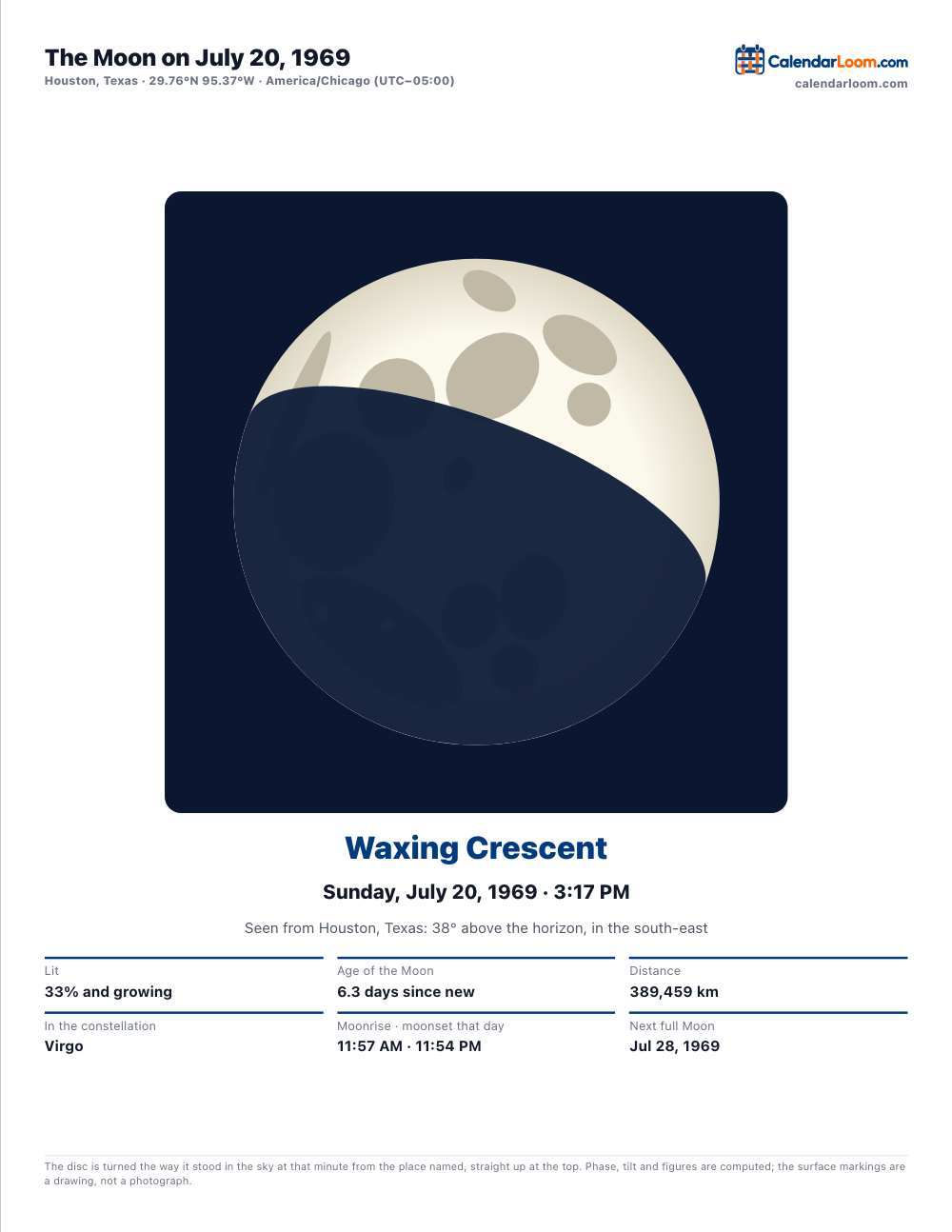
- The phase and the lit fraction, for the minute you choose rather than for the whole day.
- The tilt of the lit edge and the turn of the face, as seen from your place — including upside down from the Southern Hemisphere.
- How high the Moon stood and in which direction, or that it had not risen.
- Its age, its distance and the constellation it stood in, with that day’s moonrise and moonset.
- The grey seas on the disc are a drawing, placed where the real ones are. The sheet says so in its footer.
Check it against nights on record
A tool like this is only worth printing if it is right, so here it is run on dates whose Moon is a matter of record. The figures in the table are produced by the same code as your sheet, at build time.
| Night | Date (UTC) | Phase | Lit |
|---|---|---|---|
| Apollo 11 lands on the Moon A waxing crescent: the landing was timed for a low morning Sun at the landing site, which puts the Moon a few days past new as seen from Earth. | July 20, 1969 | Waxing Crescent | 33% |
| The Titanic strikes the iceberg The night is remembered as moonless, and it was: a thin waning crescent that had not yet risen. | April 15, 1912 | Waning Crescent | 6% |
| D-Day, the Normandy landings The invasion was planned around the full Moon, which came that same evening: it lit the airborne landings, and its spring tides laid the beach obstacles bare at low water. | June 6, 1944 | Waxing Gibbous | 99% |
| The first night of the year 2000 A waning crescent, rising in the small hours. | January 1, 2000 | Waning Crescent | 27% |
| The total solar eclipse across North America A solar eclipse can only happen at new Moon, which is exactly what the calculation gives. | April 8, 2024 | New Moon | 0% |
Why the Moon looks tilted — and upside down in Australia
The lit side of the Moon always faces the Sun. But “which way is up” depends on you. As the Moon crosses your sky from rising to setting, it appears to rotate — by about ninety degrees at middle latitudes, and by more nearer the equator: the half Moon that stands upright when it is highest leans over on its side as it sets. Astronomers call the amount of that turn the parallactic angle. From the Southern Hemisphere the Moon passes to the north instead of the south, so the whole disc is seen the other way up: the “rabbit” stands on its head, and a waxing Moon is lit on the left. The sheet applies that rotation for your place and minute, which is why two people entering the same date from Oslo and from Sydney get the same phase and a different picture.
The eight phase names
New Moon, first quarter, full Moon and last quarter are instants: the moments the Moon is 0°, 90°, 180° and 270° ahead of the Sun. The four names in between cover the stretches from one to the next — waxing crescent, waxing gibbous, waning gibbous, waning crescent. The sheet uses a principal name when the chosen minute is within about half a day of the instant, and the in-between name otherwise, so “Full Moon” means the night of the full Moon and not merely a bright one.
More from the same sky
Questions
What was the Moon phase on the day I was born?
Enter the date above. If you know the time and the place, enter those too: the Moon moves about 12° along its orbit each day, so the lit fraction changes by up to a tenth in a day, and a birth just before a full Moon and one just after it fall on the same calendar date in different places. Without a time, 9 pm is a reasonable stand-in for “that night”.
How accurate is it for dates long ago?
The position of the Moon is computed, not looked up, and between 1900 and 2100 the phase is right to well within a minute of time. The weaker link for old dates is the clock: time zones and daylight saving rules come from the public time-zone database, which is dependable from 1970 onward and an approximation before that. For a date before 1970, an error of an hour in the local time changes the lit fraction by less than half a percent.
Why does the place matter?
For three reasons. The date itself: the same instant is a different calendar day in Sydney and in New York. The orientation: the Moon appears tilted differently depending on where it stands in your sky, and from the Southern Hemisphere it looks upside down compared with the north. And whether it was up at all: the sheet says how high the Moon stood, or that it was below the horizon at that moment.
Is the picture a photograph of the Moon that night?
No, and the sheet says so. The shape of the lit part, the tilt of its edge and the way the face is turned are computed for the minute and the place you choose. The grey seas on the surface are a simplified drawing of the real ones, placed where they are on the Moon. It is a diagram of that night’s Moon, not an image of it.
Is this astrology?
No. Everything on the sheet is astronomy: where the Moon was and how it was lit. The constellation named is the one the Moon actually stood in, by the boundaries astronomers use, which is often not the star sign a horoscope would give for the same date.
Is what I type on the sheet sent anywhere?
No. The title and the message stay in your browser and go only onto the sheet and into the PDF, which is built on your own device. They are not put into shared links and not sent to analytics. Only a town name you search for is sent, to a place-search service.
May I give it as a gift, or sell prints?
Yes. Sheets you make here are yours, including for commercial use, with no attribution required.