
Night sky calendar
A year of Moon phases, eclipses and meteor showers on one printable page — dated on your own clock.

Most of what happens in the sky can be known years in advance, to the minute. What cannot be looked up so easily is the version that is true for you: on your clock, from your town, with this year’s Moon taken into account. This page computes that version and fits it on one sheet for the fridge door or the observatory wall.
What is on the sheet
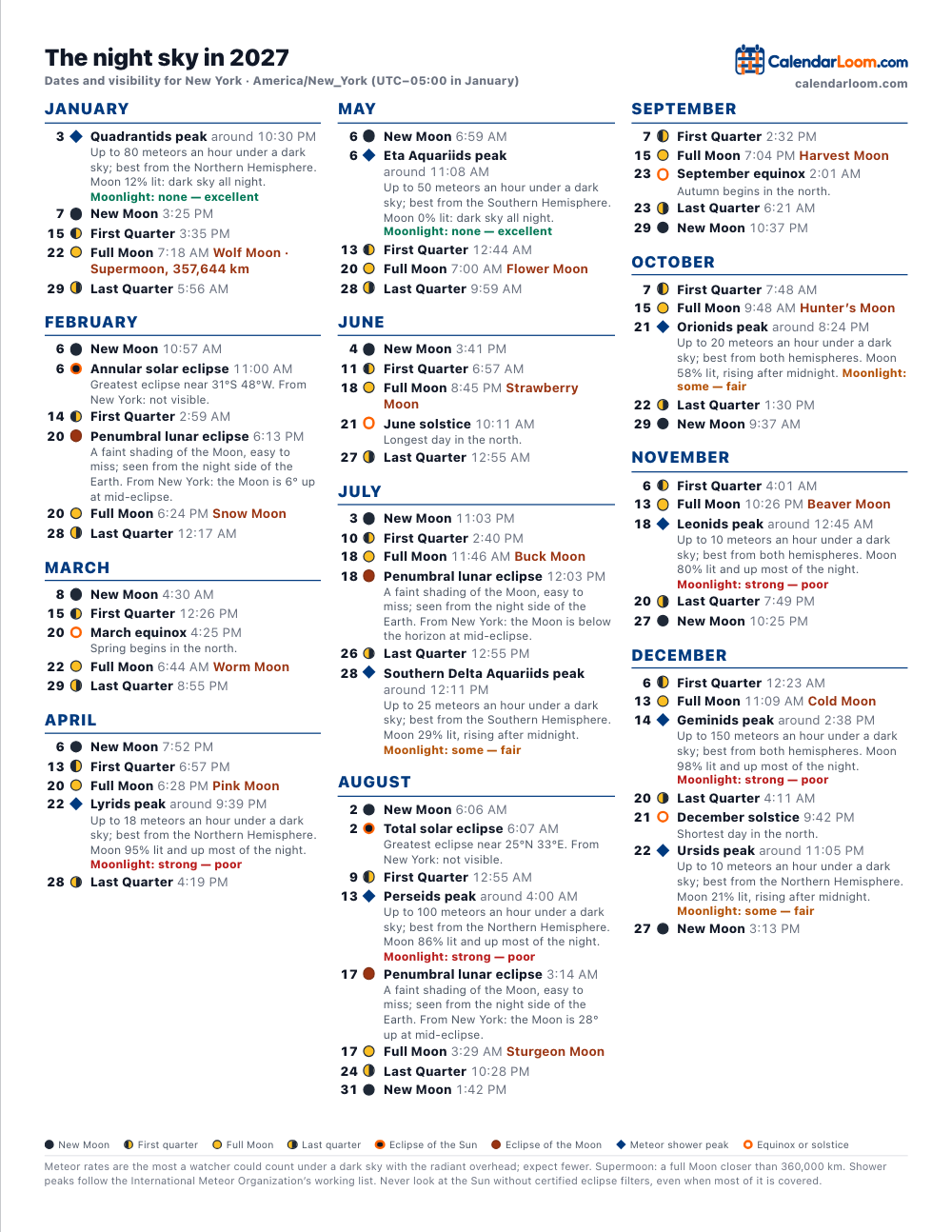
- Every phase of the Moon, with the time, and the full Moons named.
- Supermoons, with the distance, and Blue Moons, judged on your calendar.
- Every eclipse of the Sun and the Moon — and, with a place chosen, what can be seen from it.
- Nine major meteor showers, each rated by how much the Moon interferes that year.
- Equinoxes and solstices, to the minute.
The sky in 2026
13 full Moons, 4 eclipses, 1 supermoon, and a Blue Moon on May 31. Dates here are in UTC; the sheet above converts them to your clock.
Eclipses of 2026
- February 17 — Annular solar eclipse. Greatest eclipse near 65°S 87°E.
- March 3 — Total lunar eclipse. Seen from the whole night side of the Earth, totality 59 min.
- August 12 — Total solar eclipse. Greatest eclipse near 65°N 25°W.
- August 28 — Partial lunar eclipse. Seen from the whole night side of the Earth, partial phase 199 min.
Supermoons of 2026
- December 24 — Cold Moon; 356,740 km away.
Meteor showers of 2026, rated for moonlight
| Shower | Peak (UTC) | Best rate / hour | Moonlight in 2026 |
|---|---|---|---|
| Quadrantids | January 3 | 80 | Poor — bright Moon |
| Lyrids | April 22 | 18 | Good — Moon sets early |
| Eta Aquariids | May 6 | 50 | Poor — bright Moon |
| Southern Delta Aquariids | July 28 | 25 | Poor — bright Moon |
| Perseids | August 13 | 100 | Excellent — no moonlight |
| Orionids | October 21 | 20 | Poor — bright Moon |
| Leonids | November 17 | 10 | Good — Moon sets early |
| Geminids | December 14 | 150 | Good — Moon sets early |
| Ursids | December 22 | 10 | Poor — bright Moon |
The sky in 2027
12 full Moons, 5 eclipses, 1 supermoon. Dates here are in UTC; the sheet above converts them to your clock.
Eclipses of 2027
- February 6 — Annular solar eclipse. Greatest eclipse near 31°S 48°W.
- February 20 — Penumbral lunar eclipse. A faint shading of the Moon, easy to miss; seen from the night side of the Earth.
- July 18 — Penumbral lunar eclipse. A faint shading of the Moon, easy to miss; seen from the night side of the Earth.
- August 2 — Total solar eclipse. Greatest eclipse near 25°N 33°E.
- August 17 — Penumbral lunar eclipse. A faint shading of the Moon, easy to miss; seen from the night side of the Earth.
Supermoons of 2027
- January 22 — Wolf Moon; 357,644 km away.
Meteor showers of 2027, rated for moonlight
| Shower | Peak (UTC) | Best rate / hour | Moonlight in 2027 |
|---|---|---|---|
| Quadrantids | January 4 | 80 | Excellent — no moonlight |
| Lyrids | April 23 | 18 | Poor — bright Moon |
| Eta Aquariids | May 6 | 50 | Excellent — no moonlight |
| Southern Delta Aquariids | July 28 | 25 | Fair — Moon rises late |
| Perseids | August 13 | 100 | Poor — bright Moon |
| Orionids | October 22 | 20 | Fair — Moon rises late |
| Leonids | November 18 | 10 | Poor — bright Moon |
| Geminids | December 14 | 150 | Poor — bright Moon |
| Ursids | December 23 | 10 | Fair — Moon rises late |
How the dates are computed
Phases, eclipses, equinoxes and solstices are found with Astronomy Engine, an open-source library tested against NASA’s JPL ephemerides, by searching for the instant itself — the moment the Moon is exactly opposite the Sun, the moment of greatest eclipse. A meteor shower peaks when the Earth reaches a fixed point on its orbit, so each peak is found as the instant the Sun reaches the shower’s published solar longitude, taken from the International Meteor Organization’s working list and corrected for precession. Real showers are broader and moodier than one instant suggests; the listed hour tells you which night to pick, not when to look up.
More from the same sky
Questions
Why is a date here a day off from another calendar?
Almost always because of the time zone. A full Moon, an eclipse maximum or a solstice happens at one instant for the whole planet, and that instant falls on different calendar days in different places. Many printed calendars give dates in UTC or in US Eastern time. This one dates every event on the clock of the place you choose — or of your device, if you choose none — so a full Moon at 03:00 UTC is listed the evening before for Chicago.
What counts as a supermoon here?
A full Moon closer than 360,000 km, measured between the centres of the Earth and the Moon. That is the stricter of the definitions in circulation and gives one to three supermoons in most years; looser definitions that count any full Moon within 90% of its closest approach give three or four. The distance is printed beside each one so you can apply your own line.
How are the meteor showers rated?
By moonlight, which is the one thing that can be predicted years ahead. A bright Moon washes out all but the brightest meteors, so each peak is rated by the Moon’s phase that night: excellent when it is near new, good when a waxing Moon sets around midnight and leaves the pre-dawn hours dark, fair when a waning Moon rises after midnight, and poor when it is bright most of the night. The weather and your own light pollution are up to you.
Can I see the eclipse from my town?
Choose a place and the calendar says. For an eclipse of the Moon it tells you whether the Moon is above your horizon at mid-eclipse. For an eclipse of the Sun it computes what happens at your coordinates: not visible, partial with the percentage of the Sun covered, or total. Never look at the Sun without certified eclipse filters, however much of it is covered.
Where do the full Moon names come from?
Wolf Moon, Strawberry Moon and the rest are traditional North American names, popularised by farmers’ almanacs; they are folklore, not astronomy, and other cultures have their own. Two follow a rule instead of the month: the Harvest Moon is the full Moon nearest the September equinox, and the Hunter’s Moon is the one after it.
What is a Blue Moon?
In today’s usual sense, the second full Moon within one calendar month. Because it depends on the calendar date, it depends on the time zone too: a full Moon just after midnight on the 1st in Europe is still on the 31st in America, and only one of the two gets a Blue Moon that month. The calendar applies the rule on your clock.
Is my location sent anywhere?
Only a town name you search for is sent, to a place-search service. The calendar works without any place at all, on the clock of your device; everything is computed in your browser, and the PDF is built there too.