
Sunrise and sunset calendar
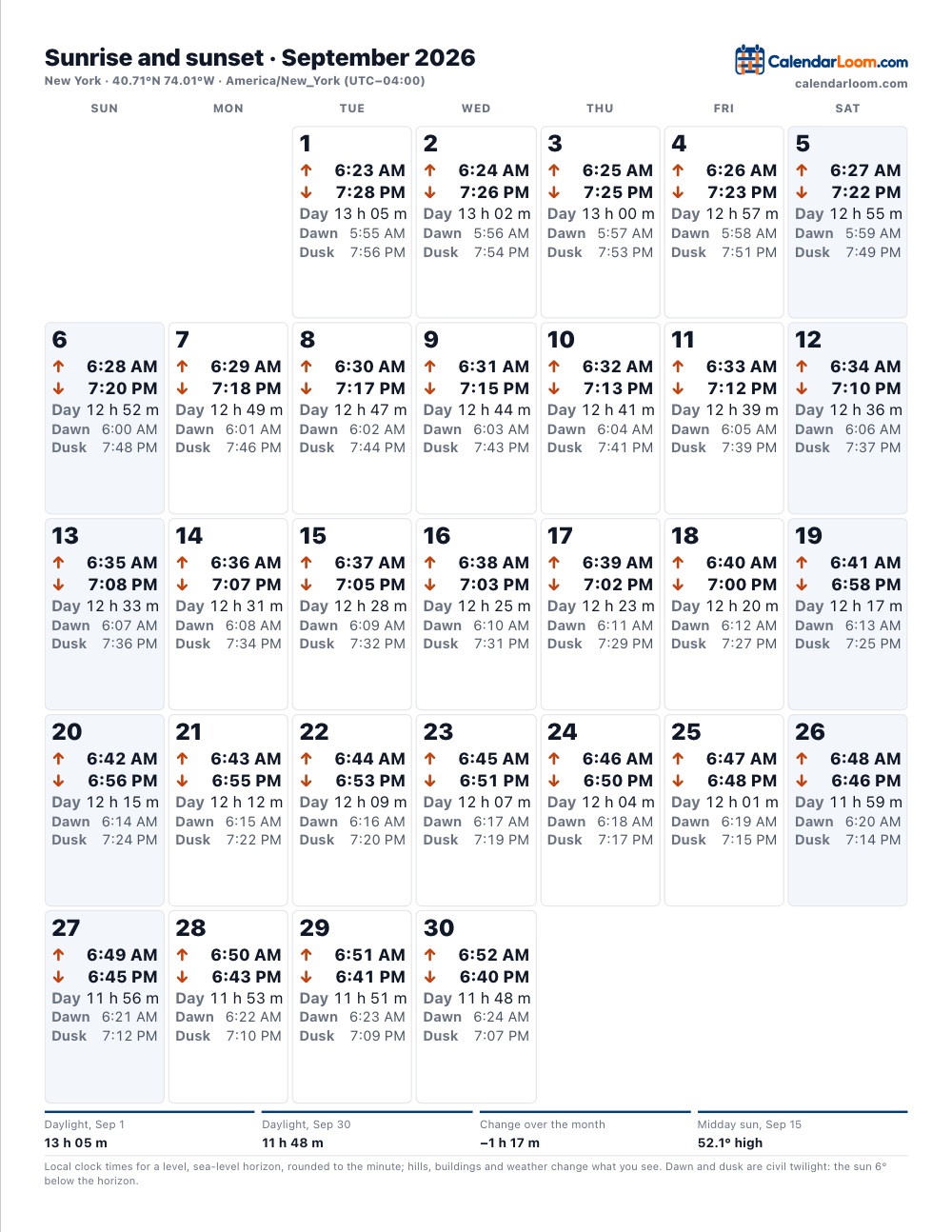
A month of sunrise, sunset and day length for any place on Earth — on one printable page.

Gardeners, photographers, anglers, runners, pilots and anyone who keeps a fast by the Sun all need the same small table: when does it rise, when does it set, and how long is the day. This makes that table for your own town, for any month from 1900 to 2100, and lays it out as a calendar you can pin to a wall.
What is on the sheet
- Sunrise and sunset for every day, on the local clock, with daylight saving applied.
- Day length — the hours and minutes the Sun is above the horizon.
- Dawn and dusk, optionally: the start and end of civil twilight, when it is light enough to work outside.
- Golden hour, optionally: when the Sun is lower than 6°, the soft light photographers plan around.
- Solar noon, optionally, with how high the Sun climbs — useful for solar panels and for shade.
- A strip underneath with the day length on the first and last day, and how much the day grows or shrinks over the month.
How long the day is, by latitude
The length of a day depends on two things only: the date and how far you are from the equator. Longitude and time zone decide when the Sun rises, not for how long it stays up. These are the figures for 2026, computed with the same code the calendar above runs, for the Northern Hemisphere; south of the equator the June and December columns swap.
| Latitude | March equinox March 20 | June solstice June 21 | September equinox September 23 | December solstice December 21 |
|---|---|---|---|---|
| Equator | 12 h 07 m | 12 h 07 m | 12 h 06 m | 12 h 08 m |
| 10°N | 12 h 07 m | 12 h 43 m | 12 h 06 m | 11 h 33 m |
| 20°N | 12 h 07 m | 13 h 21 m | 12 h 06 m | 10 h 55 m |
| 30°N | 12 h 07 m | 14 h 05 m | 12 h 07 m | 10 h 13 m |
| 40°N | 12 h 08 m | 15 h 01 m | 12 h 07 m | 9 h 20 m |
| 50°N | 12 h 10 m | 16 h 22 m | 12 h 08 m | 8 h 04 m |
| 60°N | 12 h 13 m | 18 h 52 m | 12 h 10 m | 5 h 52 m |
| 70°N | 12 h 18 m | 24 h 00 m | 12 h 15 m | 0 h 00 m |
At 40°N — Madrid, Beijing, Philadelphia — the day runs from 9 h 20 m in December to 15 h 01 m in June. At 60°N — Oslo, Helsinki, Anchorage — it runs from 5 h 52 m to 18 h 52 m. Two details in the table surprise people. The equinox day is not exactly twelve hours anywhere: sunrise and sunset are counted from the Sun’s upper edge, and the air bends its light over the horizon, which together add several minutes. And at the equator the day is a few minutes over twelve hours all year for the same reason.
How the times are computed
Nothing is looked up from a table. The position of the Sun is calculated in your browser with Astronomy Engine, an open-source library whose results are tested against NASA’s JPL ephemerides, and the moment of sunrise is found by searching for the instant the Sun crosses the horizon — which keeps working at high latitudes, where the textbook sunrise formula has no answer. The calculation is checked against published times for cities on five continents, and against the awkward cases: the midnight Sun in Tromsø, a sunset after midnight in Reykjavík, and the 23- and 25-hour days when the clocks change.
More from the same sky
Questions
How accurate are the sunrise and sunset times?
To the minute, for a level horizon at sea level. Sunrise and sunset are the moments the upper edge of the Sun touches the horizon, with the standard allowance for atmospheric refraction (the Sun’s centre 0.833° below the horizon) — the same convention almanacs and weather services use. Hills, buildings and unusual air temperatures shift what you actually see by a few minutes.
Why does my weather app show a time one minute different?
Because of rounding and coordinates. A town is not a point: two services that place its centre a few kilometres apart differ by several seconds, and rounding to the minute turns that into a minute. Differences larger than two minutes usually mean a different time zone or a different definition of the horizon.
What are dawn and dusk on the calendar?
Civil twilight: the Sun between the horizon and 6° below it. It is the period with enough light to be outdoors without lamps, and the definition used for lighting-up rules in many countries. The daylight chart on this site also draws nautical (12°) and astronomical (18°) twilight.
Does it handle daylight saving time?
Yes. Times are on the local clock of the place you choose, using its real time-zone rules, and the day the clocks change is marked in its cell. That day is 23 or 25 hours long, which is why sunrise appears to jump by an hour.
What happens north of the Arctic Circle?
The calendar says so. When the Sun stays up the cell reads “up all day”, when it never rises it reads “down all day”, and in the weeks between, a sunset that falls after midnight is marked +1.
Is my location sent anywhere?
Only the town name you type is sent, to a place-search service, so that it can be found. The coordinates, the dates and the finished calendar stay in your browser: the times are calculated on your own device, and the PDF is built there too.